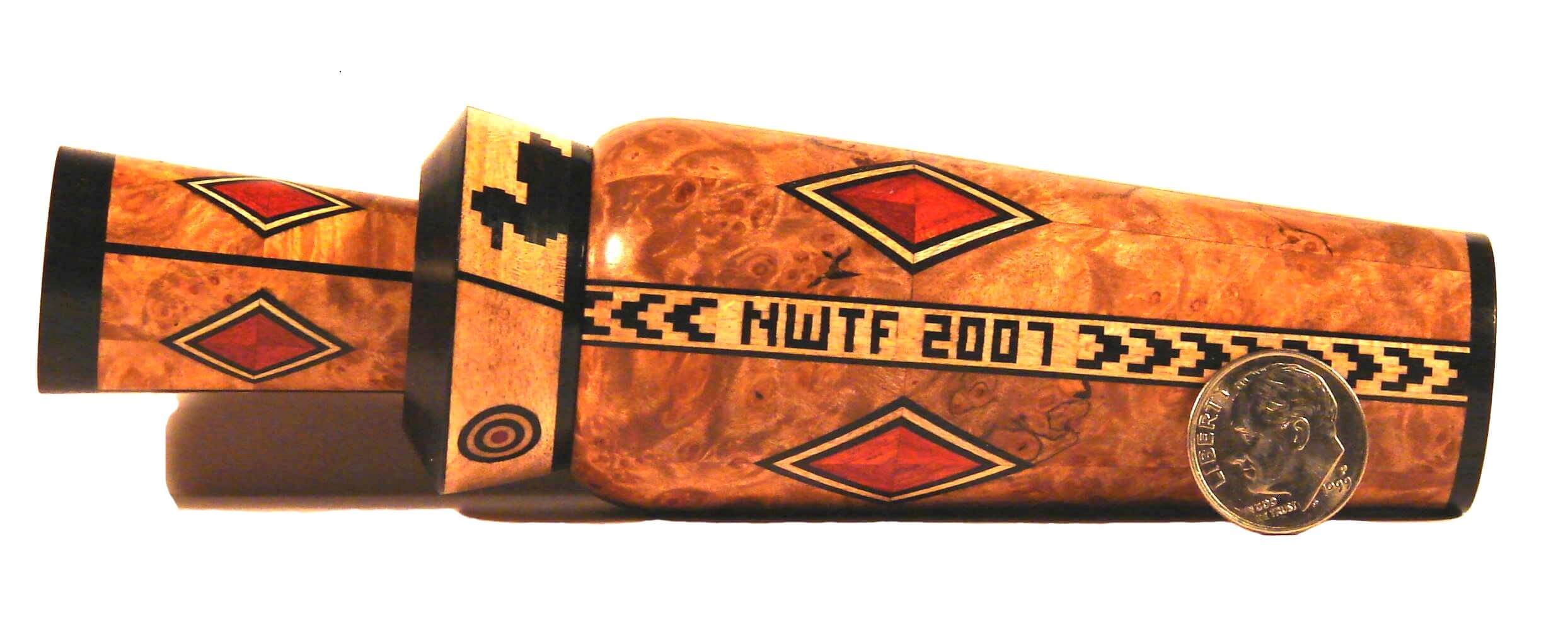
The Robertson duck call below was made for the 2007 NWTF Convention and Sports Show.
I maintain and accuracy of 0.001 of an inch on wood.
once I finish some new machinery.
If you have questions about my duck calls or inlay work, please feel free to contact me.
Take a look around and check out the other parts of my site.
About Myself and How I Got Started with Robertson Duck Calls.
The following is an Article my son Matt wrote for a magazine that shares a lot about myself, and how I got started into making this small inlay and duck calls: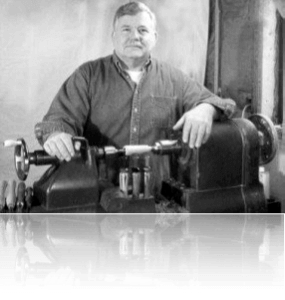
With his 5,000 sq. ft. shop full of numerous tools and contraptions, plus his history of woodworking, Ray has picked up duck call making fairly quick. With an arsenal of ideas and jigs, Ray plans to change the way people make and perceive duck calls with inlay.
Ray started working as a carpenter when he got out of the service after spending two and a half years in Asia. He started a framing business and later he built large homes, “I always loved working outside,” Ray said. Ten years ago he went back to the tools in his shop and worked on designing and making architectural pieces like mantles, doors, stair cases, etc… He really got into woodturning, and especially ornamental lathe turning. Ray has always loved to design and make things out of wood.
Ray moved to Nixa, MO. from Independence, MO. about thirty years ago. “I love living in the Ozarks. I hunted in the area when I was a boy. Now I camp and hike in the Ozarks with my family and a lot of the time with the Boy Scouts, which my wife and son are both members of. It is a great way to teach the boys about nature and animals.”
Ray has always cared about the conservation of wildlife. He is a member of Callmakers & Collectors Association of America, Midwest Decoy Collectors Association, and Ducks Unlimited. He has donated several calls to Ducks Unlimited auctions, with the proceeds going to the preservation of habitats. He is also a member of the American Association of Woodturners, Society of Ornamental Turners in England, and Midwest Tool Collectors Association.
For the last two or three years Ray has been talking to Terry Pettitt, a painter on the job site and a duck call collector, about making duck calls. He showed him a desk pen and eagle 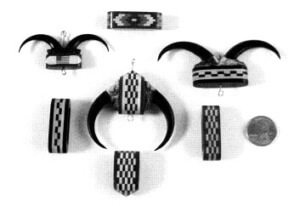 claws mounted on an inlayed base, which he has been making for five years for the tribe of Mic-O-Say, a camping program out of Kansas City for Boy Scouts. After seeing Ray’s work, Terry introduced him to duck calls and told him that he should try it out.
When he finally got started making Duck calls in 2003, Terry was a great help in loaning him books, duck call magazines, and giving him feedback, so he could do research and come up with his own designs and characteristics. After coming up with a design that he was happy with, then came the fun part. How do you make one? What kind of mandrill and jigs will it take?
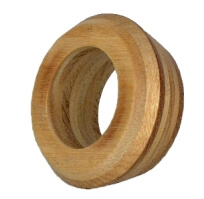 Ray wanted to make an inlay duck call that had a wooden ring and a medium size body that would have a smooth feel and have a nice fit to your hand. The round ring at the top of duck call was his first challenge, because he preferred not to use a metal band on the ring like most duck call makers do. Ray wanted to use an all wooden ring, because he thought it would be unique and he also felt that the wooden ring would give him more design opportunities in the future. He knew the ring was important in the type of call he made, because he wanted to use an old style taper fit for the stopper.
To accomplish the structural part of the ring Ray crisscrossed the layers similar to plywood, with up to five to seven layers. This creates plenty of strength to prevent cracking, but it also produces a turning problem with having to turn into the end grain of the different layers of wood. Ray has overcome this problem and has used the layering to present different variations of color in his calls. Ray has talked to a several collectors, and everyone has felt that no one has ever made a ring in this manner.
For the general work on the body of the duck call, Ray uses a Powermatic M-90 wood lathe which he has used for many years. He has a 13-40 metal lathe which he uses for a lot of his boring and drilling. He does step drilling on the inside of the body to place a maple cylinder in the call to hold the wooden ring to the body. Ray designs and makes all of his own inlay using a bandsaw and machinist tools. He does not use any CNC machines to do any of his work. Although one may think that, because of the quality of his work.
Ray had to learn how to do his own machinist work in order to make a lot his jigs, tooling, and machines. He has made machines for making the slot for the tone boards and for indexing the inlay in his calls. Being able to do machinist work has opened a whole new design area and gives him the ability to build unique calls in the future.
Ray prefers to use all natural woods in his calls with no stains. He uses a variety of woods to create an assortment of colors. His favorite native woods are dark walnut, cherry, and maple. His favorite exotic woods are African Blackwood, because it brings out the color of other woods so well, and Cocobolo, because it has a great contrast of colors within it. He would also like to make some duck calls out of pink ivory; he finds the dark red to be unique. Ray has also used some Ivory and hopes to use more in the future.
After coming up with a final design in 2003, he decided to make his first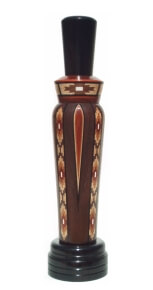 call for the St. Charles show, which he placed 2nd in Amateur class. In 2004 he decided to enter the NWTF show and won 3rd in lamination. There was a small discussion over if the inlay was bought or made. “Terry and I thought this might happen before I sent the call in.” Ray explained, “The inlay was designed and handmade by me, with ivory pieces in the inlay to verify it.”
In 2003 he made calls with American flags which he purchased the flag only; the rest of the inlay was made by him. In the future he plans on making more calls with flags in them. But with new tools and machinery, he designed, Ray plans on making his own flags and smaller more intricate inlay, which will enable to inlay dates and events, which he did in the 2005 CCAA contest. “And yes I do use a magnifying glass when putting them together,” Ray jokes. Turners and woodworkers have always had a built in rival of how small you can go.
“Lamination will always be my favorite choice to make, because of the many challenges it presents and the color contrasts that different woods create. As soon as I design and build new tools I have some more wild designs coming in the future,” Ray stated. He plans on also making duck call racks, display cases, wall display cabinets for duck calls or turkey calls, and other collectables. He even wants to make unique coffee tables that have open glass to display collectables, since he has a background in custom architecture and cabinetry. He is always taking in new ideas and is starting a website at www.ozarkwoodworker.com. There people can submit plans and place orders on his calls.
“My future plan in duck call making is to come out with a working call and also come out with calls in the carved division and open class.” Some of his future calls are going to be very unique because they will be made on machines that were designed and made in the 1700-1800’s that he purchased which include an ornamental lathe, a rose engine lathe and a straight line machine. Ray stated, “I’m looking forward to designing and perfecting my duck call making for use and collecting. And the collectors can look forward to see more of my calls in contest in the future.”